Start at one corner of a Keller acre lot and pace the back line off. By the far corner, past where the old fence has started to lean, the count has stopped feeling like a backyard project. On a Keller lot, footage is not a detail. It is the whole quote, and the number homeowners here most often guess wrong.
That is why the estimate comes first: a range built from your real footage and material, then a local contractor measures in person and writes the quote. Fences Texas is a match, not a fence crew. Describe your yard once, and a Keller contractor measures it and writes the price for you to accept or turn down.
Rough footage is fine. No phone number needed for the estimate.
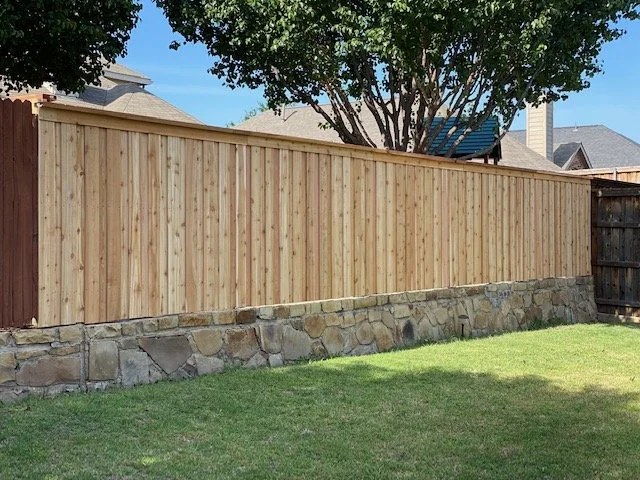
Board-on-board cedar privacy fence with trim and cap, built on a stone base.
Estimate my fence cost
Start with a ballpark for your yard. No phone number needed for the estimate.
Step 1 of 2: Your estimate
Homeowners across DFW get matched with local fence pros
What happens next
1
Run the calculator, then send the form.
Rough length, new or replacement, your address. The ballpark comes before any phone number is asked for.
2
His call sets the visit.
Your contractor calls to go over the details and book the measurement.
3
A broken-out written price follows.
Removal, gates, and the permit each get their own line. Say yes if it makes sense, no if it does not.
The finished fence, and the ground it stands in
From the curb, a good fence out here holds a cedar line true over a long run across ground that rises and dips, lets every gate close without dragging, and gives privacy without walling off the mature trees. On lots backing onto a park, trail, or open space, Keller requires that line to be wrought iron or tubular steel instead of wood: an open iron fence that keeps the view and marks the boundary.
Keller sits at the edge of the Blackland Prairie in northeast Tarrant County, mostly on expansive clay. Rain swells it, a dry summer shrinks it hard, sandy loam fills pockets, and near Big Bear Creek sandier topsoil sits over clay. One side of a run can move faster than the other. That is why posts here go deep and get locked in concrete: a shallow one tips a little more each wet and dry cycle.
Before you sign, pin him down on post depth, and on what grips each post after a dry spell pulls the clay away.
Pricing a Keller fence starts with the length of the run
Length drives the price here, because Keller lots are simply long. A standard subdivision run and an SF-36 lot with a couple hundred feet of depth are different jobs even when the material matches. What you build from moves the total next: cedar at the top, pine at about half its per-foot cost, iron between the two, pool mesh on its own terms.
Large properties tend to need more gates, and replacements add old-fence removal. Put your length into the calculator for a useful range in roughly thirty seconds, a planning number, not a final price. That gets set on site, in a written quote listing removal, gates, and the permit separately.
Rough footage is fine. No phone number needed for the estimate.
The paperwork and the digging are part of the job you are hiring out
Every new fence in Keller needs a city permit, as does a replacement once it reaches 8 linear feet, with a city inspection at the end. Replace most of an older fence and the new work meets current code. Wood next to a street or alley shows its smooth side outward. None of that is homework for you. Getting any required fence permit is included in his job, along with building to the rules for your lot. If your subdivision wants HOA sign-off first, he handles that too, and plenty of Keller subdivisions do.
Before digging, buried lines are marked through an 811 call. For replacements, pulling the old fence and hauling it away are figured into the quote.
How getting matched works
1
The contractor comes out to measure.
He walks every foot, checks corners and gate spots, and prices what is there. Post depth and setting material show up on the quote.
2
Then the decision is yours.
The price is broken into parts. Whether you hire him or not, you keep the paperwork.
3
After the build, walk it together.
Go down the finished line with the contractor before final payment, and point out anything that looks off.
After you send the form: Your contractor will call within one business day to schedule your free measurement. Use that conversation to pin down the specifics and lock in when he comes out to measure. Your number is not sold, there are no robocalls, and nobody pushes you to sign. Every matched contractor backs the work with a one-year workmanship warranty in writing.
Cedar, pine, or iron: the short version
Cedar handles most long privacy runs here: rot-resistant, good under stain, and board-on-board stays closed when August heat opens gaps elsewhere. Pine is the money saver on a long lot, about half the per-foot cost, though it weathers faster. Iron fits where Keller calls for an open fence, along parks, trails, and drainage ways, and around pools where the view matters. Pool mesh suits a lighter barrier that can come out.
Keller fence questions
How much will my Keller fence run?
Length and material set the total, and here length usually matters more. Feed your numbers into the calculator for a planning range. Cedar costs about twice what pine costs per foot, iron sits between them, and each gate is priced on its own. The final figure is locked in at the site visit.
How long does the whole thing take?
Most fences are finished within 2 to 3 weeks of the quote visit. Once the crew starts, most backyard fences go up in 1 to 2 days, though a very long run can take longer.
Do I have to stay home for the visits?
Being there for the measuring visit helps, since gate and line choices settle easier face to face. Install day is different: most homeowners head out, as long as the crew has gate access and the dogs have a plan.
What about the permit and my HOA?
Your contractor takes care of it. Keller requires a permit for a new fence and for replacing 8 linear feet or more, and handling any required fence permit is part of his job. Need HOA approval first? Note it on the form. Hidden Lakes and Marshall Ridge each set their own limits on height, materials, and stain.
My back line sits on a park or a trail. Can I still use wood?
Probably not on that line. Keller requires fencing next to a park, trail, open space, or drainage way to be wrought iron or tubular steel. Your contractor confirms which lines that touches at the measurement, and the quote prices them in iron.
How does the match work, and what do I pay for it?
You pay nothing for the match. Send one description of the work, we connect you with a Keller contractor, and he prepares a broken-out written quote. He calls to schedule the measurement and go over the details. You pay only a contractor you actually hire. Too high a price ends it.
Only one side of my fence is failing. Can that side be replaced alone?
Yes, with two Keller thresholds. A permit kicks in at 8 linear feet of replacement, and once 60 percent or more of an old fence is replaced, the entire fence has to meet today's code. Replacing one side is common work. Say so on the form, and add whether that line is shared.
Get your Keller fence priced
Spring schedules in Keller fill fast, and jobs go in the order they come in. Get the estimate first, then judge by the written quote.
Rough footage is fine. No phone number needed for the estimate.